
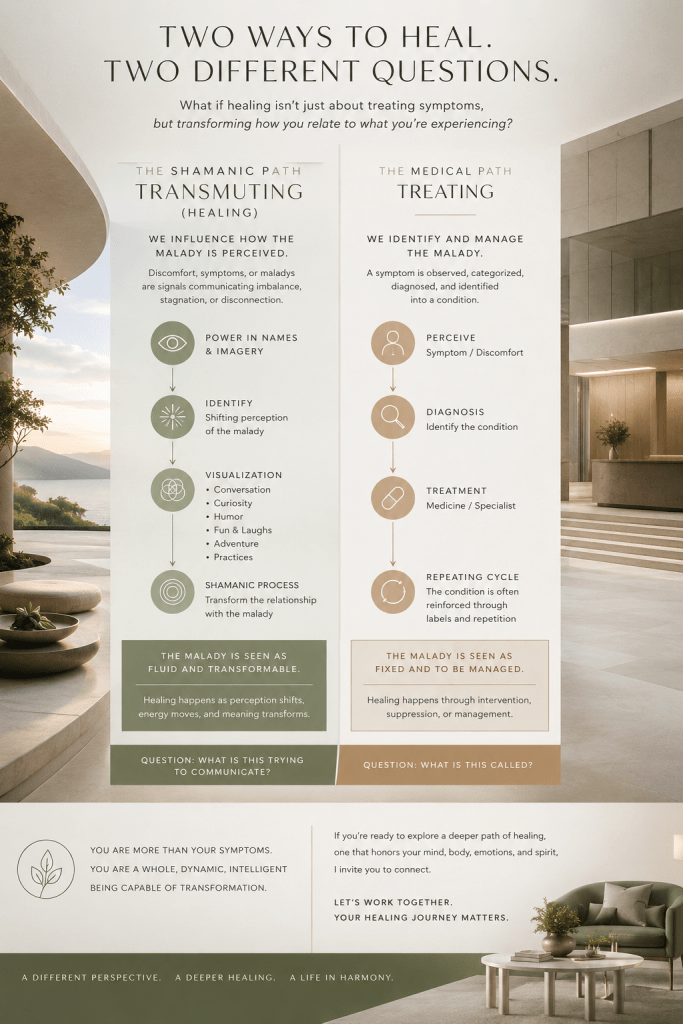
Many healing traditions throughout the world begin from a fundamentally different perception of human discomfort than the modern medical model. In the shamanic or “transmuting” approach, symptoms, maladys, emotional heaviness, or energetic disturbances are not automatically perceived as permanent diseases or fixed conditions. Instead, they are understood as energy communicating imbalance, stagnation, disconnection, or unresolved patterns within a person’s life and experience. Because of this, healing is approached not only through intervention, but through transformation of the relationship between the individual and the malady itself.
Within this perspective, there is deep power in names, imagery, visualization, and the stories people continuously repeat about themselves and their discomforts. The shamanic process attempts to influence how the malady is internally experienced through conversation, curiosity, humor, fun, laughter, adventure, meaningful practices, ceremony, and expanded perception. Rather than reinforcing the discomfort as a permanent part of the identity, the process seeks to soften rigidity around it and create flow where there was once energetic fixation. In many traditions, joy itself is viewed as medicine because it interrupts contraction and restores growth within the psyche, body, and spirit.
The conventional medical model often follows a different sequence. A symptom is observed, categorized, diagnosed, and identified into a condition, after which treatment is pursued through medicine or specialists. This system has extraordinary strengths and has saved countless lives, particularly in emergency intervention, trauma care, surgery, and acute conditions. Yet from the shamanic perspective, there can also be a risk in repeatedly reinforcing the malady through labels, fear, and continual identification with the condition itself. One process primarily asks, “What is this called?” while the other often asks, “What is this trying to communicate?”
Shamanic healing therefore does not necessarily reject modern medicine. Rather, it expands the field of perception around healing itself. It recognizes that human beings are deeply influenced by meaning, emotional states, imagination, memory, relationships, environment, symbols, and energetic interpretation. The healing process becomes participatory instead of passive. The individual is no longer seen merely as someone carrying a condition, but as someone capable of entering into relationship, dialogue, and transformation with the experience they are moving through.
If you are currently navigating a physical discomfort, emotional heaviness, exhaustion, confusion, or a recurring life pattern that feels unresolved, perhaps what is needed is not only management of the symptom, but a deeper exploration of what your mind, body, emotions, and spirit may be attempting to communicate. Healing does not always begin the moment something disappears. Sometimes it begins the moment a person starts relating to themselves with greater awareness, curiosity, compassion, and presence. If this perspective resonates with you, I invite you to reach out and explore this work together in a grounded, safe, and deeply human way with me.


Leave a comment